
Finding a voice in Indonesian
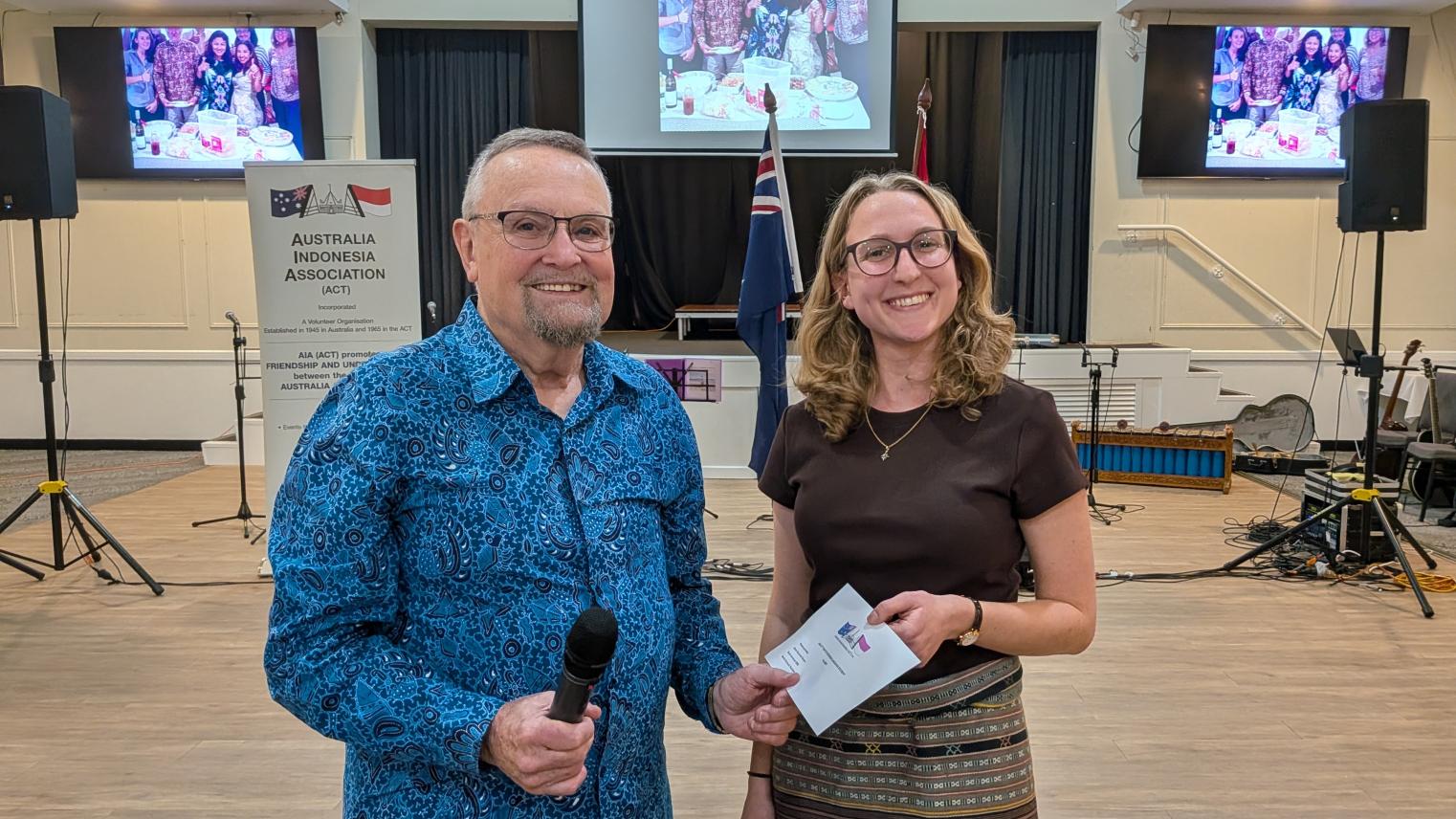
When Trudy Francis chose Indonesian in high school, it was not because she had already imagined herself studying Indonesia at university.
She simply wanted to learn a language, and Indonesian was one of the options available at her school.
Growing up in Darwin, however, the choice was not entirely removed from the world around her. She had family connections to Timor-Leste, many friends who spoke Indonesian, and an early familiarity with the region that would later become increasingly important to her.
Seven years on, that school subject has developed into a deeper interest in Indonesia, its history and politics, and the relationship between Australia and its nearest neighbours.
Now studying at the School of Culture, History & Language (CHL), within ANU College of Asia and the Pacific (CAP), Trudy has been named the top third-year Indonesian language student for 2025 and awarded the Australia Indonesia Association Prize.
She was surprised to learn that she had been considered for the award.
“I didn't know that this prize existed or that I would be considered for it,” she says. “I felt honoured though, especially because my confidence in my Indonesian skills has grown a lot in the last year.”
For Trudy, one of the biggest challenges has been finding the confidence to speak.
She describes herself as quite introverted and says shyness around speaking Indonesian was a significant barrier. She was often nervous about speaking in class or starting conversations outside it. Her classes at CHL gave her a supportive environment in which to make mistakes, but it was a month in Kupang, in East Nusa Tenggara, last year that changed her relationship with the language.
Immersed in Indonesian, she had to use it whether she felt ready or not. The experience showed her that mistakes were not something to fear, and that people responded positively to the effort to communicate.
“I realised that people are very understanding when you make mistakes and appreciate when you make an effort and are willing to learn,” she says.
That willingness to push beyond what is comfortable has also shaped Trudy's academic work. In ASIA3108 Research Topics in Asian Languages, she spent a semester researching and writing a paper in Indonesian. The small class allowed students to pursue different topics while learning from one another, exposing her to new questions about Indonesian history, politics and society.
The experience pushed her Indonesian further than language exercises alone could. She developed her ability to read academic Indonesian texts, write at greater length and engage with a subject in depth.
“This class has been the highlight of my degree at ANU,” she says.
Her interest now extends beyond learning the language itself. Studying Indonesian has changed the way Trudy thinks about Australia's relationship with the region, and about the complexity of Indonesia itself.
She sees language as a way of moving beyond the broad impressions of Indonesia that Australians can encounter through media or tourism, towards a more detailed understanding of its people, places and histories. Indonesia is geographically close to Australia, she says, but learning its language creates another way to engage with that proximity.
That is part of what she hopes to continue exploring through Honours and further research into Indonesian history and politics. She is also continuing to develop her language skills, including through translation, and is keen to return to Indonesia next year.
So far, her experience of the country has been limited to Kupang. She would like to see more, with friends suggesting Yogyakarta as a possible destination.
There is a practical purpose to the prize, then, but for Trudy the opportunity is part of something larger: continuing to learn, travel and listen.
“All of the above!” she says when asked what comes next — more Indonesian, further research, translation and travel.
What began as a choice between the languages available at a Darwin high school has become a way of listening more closely to Australia's region — and finding her own place within it.